Life Science and Healthcare

Groundbreaking analytical methods and modifications for tomorrow’s materials.
New therapies and diagnostics rely on materials that are more precise, more adaptive, and more efficient.
Hi-Acts supports life science and healthcare innovation with groundbreaking analytical and modification methods that reveal molecular-level insights and open up new development pathways.
Through industry–science partnerships, we give you access to accelerator-based technologies that turn materials into medical breakthroughs.
Overview
1. Enabling collaborative research
Fundamental radiobiological research:
Comprehensive spectrum of electron, proton or ion beams with varying beam qualities as well as various additional possibilities (e.g. in-flight selection of isotopes).
Radiobiological Research: Generation of particle or cosmic radiation (e.g. Galactic Cosmic Radiation, Solar Particle Events) enables comprehensive, cost-effective studies of radiation effects on biological systems, from cell cultures and organoids to animal models.
2. Enhance Therapy Methods
Enhanced Radiation Therapy: Reduction of radiation dose through sensor technology for in-situ, in vivo monitoring as well as optimized radiation delivery using raster scan method.
New therapy methods: Analysis of innovative ultra-short radiation applications such as Very High-Energy Electron (VHEE) or Flash Radiotherapy.
3. Treatment of Tumor Patients
Treatment of Eye Tumors: Since 1998, more than 4,600 patients have been treated at HZB in cooperation with Charité Berlin. In most cases, this not only preserved the eye but also maintained satisfactory vision.
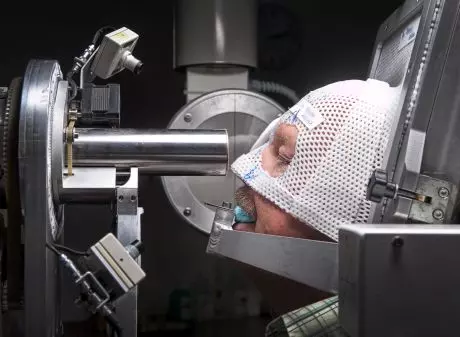
Since 1998, eye tumours have been treated with proton irradiation at Helmholtz-Zentrum Berlin HZB in cooperation with Charité Berlin. More than 4,600 patients have already been treated in this way.
Learn more
GSI Helmholtzzentrum für Schwerionenforschung, THM and Varian are developing a 3D-printed modulator that helps to adjust the dose and range of an ionised light flash to the tumour.
Learn more
To close the gap between preclinical research and clinical application, Deutsches Elektronen-Synchrotron DESYs PITZ accelerator now provides state-of-the-art infrastructure for in vivo validation at the FLASH beamline.
Learn moreJOHANNES TENTEN
Innovation Manager
Would you like to discuss our range of services? Then give us a call or arrange an appointment with one of our innovation managers.
Submit your request now